 Gable Roofed
 School Classroom
 Golf Room
 Snooker Room
 Home Office
 Home Gym
 Garden Annex
 Garden Studio
 Cinema Room
 Cocktail Bar
 Indoor Pool
 Beautician's Studio
 Café Area
Composite Garden Rooms in Lincolnshire
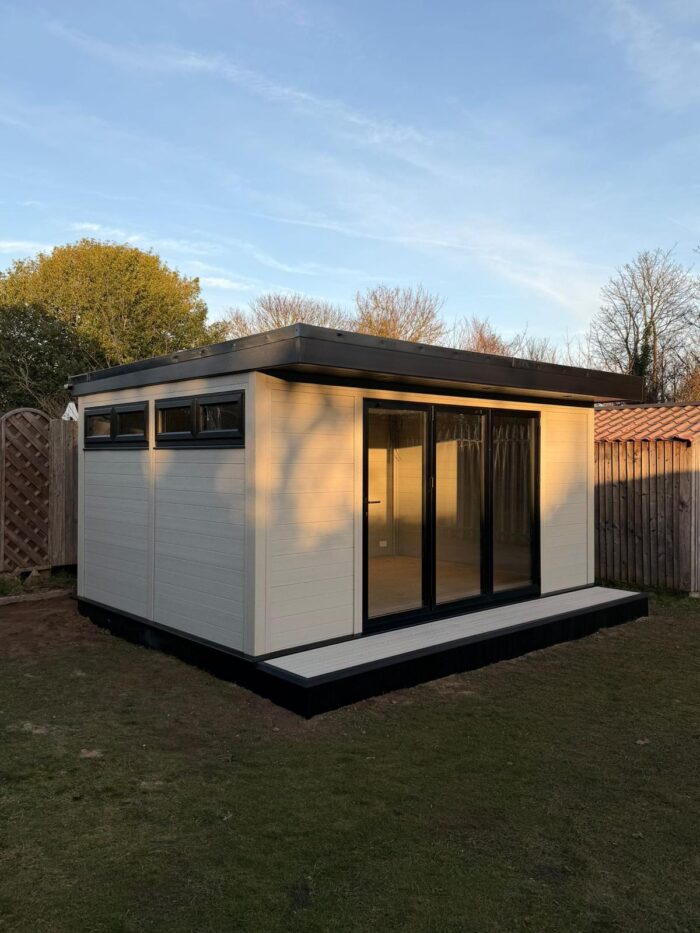
Professional Composite Garden Rooms in Lincolnshire
A composite garden room is a fully insulated year-round-usable standalone building constructed from a wood-polymer composite material rather than traditional softwood timber. The composite is a homogeneous mix of recycled timber and recycled PVC polymer with a co-extruded high-polymer skin, giving the appearance and warmth of timber without any of the maintenance. For Lincolnshire specifically, composite is meaningfully better than timber because the salt air, wind exposure and seasonal damp across the county destroy softwood garden buildings within a decade. Properly built composite garden rooms in Lincolnshire cost £12,000 to £22,000 fitted and are installed in 3 to 4 days on site.
From working with clients across the county, we’ve replaced enough rotting timber buildings with composite ones to have a clear picture of where timber falls short in this climate. This guide walks through what composite actually is, why it suits Lincolnshire specifically, what it costs, and what to expect from the material over its lifetime.
What composite material actually is
The composite in our garden buildings is 55% recycled timber and 35% recycled PVC polymer with a co-extruded high-polymer skin. Originally developed for decking and cladding, the material was designed to survive constant weather, UV and moisture exposure without the maintenance regime of timber.
Applied to garden room walls, the properties translate directly: cannot rot, cannot corrode, resists mould and algae, doesn’t need painting or staining, doesn’t warp or crack with seasonal cycling. The walls carry an embossed woodgrain finish in five colour options (Oyster Grey, Walnut, Light Grey, Dark Grey, Black). Visually the material is close enough to painted or stained timber that most people don’t notice the difference until they’re up close. The full features and benefits breakdown covers the technical background.
Why composite outperforms timber in Lincolnshire
Lincolnshire’s climate is genuinely hostile to softwood timber garden buildings.
Coastal salt exposure. Within fifteen miles of the coast (Skegness, Mablethorpe, Sutton-on-Sea, Chapel St Leonards, Ingoldmells, Wainfleet), salt-laden air accelerates rot in softwood. We’ve replaced timber garden buildings on the coast where visible deterioration was setting in within four to six years despite regular re-staining. Composite doesn’t care about salt.
Wind loading on flat exposed ground. Much of the Fens, the coastal strip and agricultural land around Boston, Spalding and Holbeach has no natural windbreaks. Wind-driven rain finds every joint in a timber building and accelerates rot at each one. Composite walls have no exposed timber joints.
Seasonal damp. Lincolnshire’s coastal proximity means atmospheric moisture is higher than inland regions of similar latitude. Softwood absorbs and releases moisture with the seasons, swelling and shrinking until joints loosen and cracks develop. Composite is dimensionally stable across the seasonal moisture range.
In our experience, composite works better than traditional timber for around 95% of Lincolnshire installations because the total cost of ownership over 20 to 30 years is significantly lower once maintenance, re-staining and eventual replacement are factored in. Clients we installed for whose neighbours built timber garden rooms at the same time consistently report their neighbours’ buildings looking visibly worse a decade later.
The maintenance advantage in practical terms
A traditional timber garden building needs re-staining every two to three years, annual joint inspection, roof membrane checks, board replacements as they fail, and typically full replacement or major refurbishment between years 15 and 20. Realistic annual maintenance cost for a 4m x 3m timber building: £150 to £300 in DIY materials, or £400 to £700 if you pay someone.
A composite garden building needs an occasional wipe-down with a garden hose if it gets dusty. That’s genuinely it.
Over a 25-year lifetime, the maintenance saving alone pays for the composite premium several times over. The no rotting, painting or staining page covers what the material does and doesn’t need in more detail.
What it costs in Lincolnshire
Most Lincolnshire composite garden rooms we install land between £13,000 and £22,000 all-in:
- Ashmere: £12,096 fitted (3322 x 2322mm)
- Oakland: £12,385 fitted (same footprint)
Base spec includes fully insulated composite walls in your colour choice, EPDM insulated roof, anthracite PVCu windows and doors with multi-point locking, insulated floor, ceiling cover, one socket with spotlights and fuse box, VAT, and full installation. Foundations (£900 to £2,200 for ground screws) and extras (AC, additional electrics, upgraded doors) sit on top. Full pricing model by model is on our garden room prices page.
For comparison, cheaper timber garden buildings at £6,000 to £9,000 look like a saving but rarely are. Over 20 years, factoring in re-staining, roof felt replacement around year 10, joint repairs from year 8, and typically full replacement by year 18 to 20, total ownership cost often exceeds the composite alternative. We’ve had several enquiries in the last 18 months from clients replacing sub-£10,000 timber buildings that reached end-of-life within seven to ten years.
The install process
A typical Lincolnshire install runs 4 to 6 weeks from order to delivery, with 3 to 4 days on site. Day one is foundations, day two is walls and roof structure, day three is doors, windows, internal finishes and electrics, day four covers snagging.
Because the composite walls are self-finished, there’s no plastering, no drying time, and no second visit from a decorator. The team at Piper Garden Rooms manages the whole process in-house, which matters because roughly two-thirds of the remedial issues we get called out to fix on other suppliers’ buildings come down to disconnects between separate sales, manufacturing and installation teams.
We deliver free of charge within a 70-mile radius of Skegness, covering virtually all of Lincolnshire, from the coast at Skegness and Mablethorpe through the Wolds around Louth and Horncastle, across the Lincoln area, out to Gainsborough and Market Rasen in the north, and down through Sleaford, Boston, Spalding, Grantham and Stamford to the south.
Working out whether composite is right for you
The honest test: if you want a garden room that will look essentially the same at year 20 as it does at year one, without ongoing maintenance cost or effort, composite is the answer. If you’d rather pay less upfront and accept an ongoing maintenance regime with a shorter lifespan, timber is workable.
Our online garden room designer lets you configure size, colour, roof type and extras with indicative pricing in a few minutes. For a conversation about material choice, spec for your specific Lincolnshire site, and how composite compares against alternatives, request a callback and we’ll come back to you the same working day.
Finished composite installations across Lincolnshire are on our Instagram, with build-day footage on TikTok.